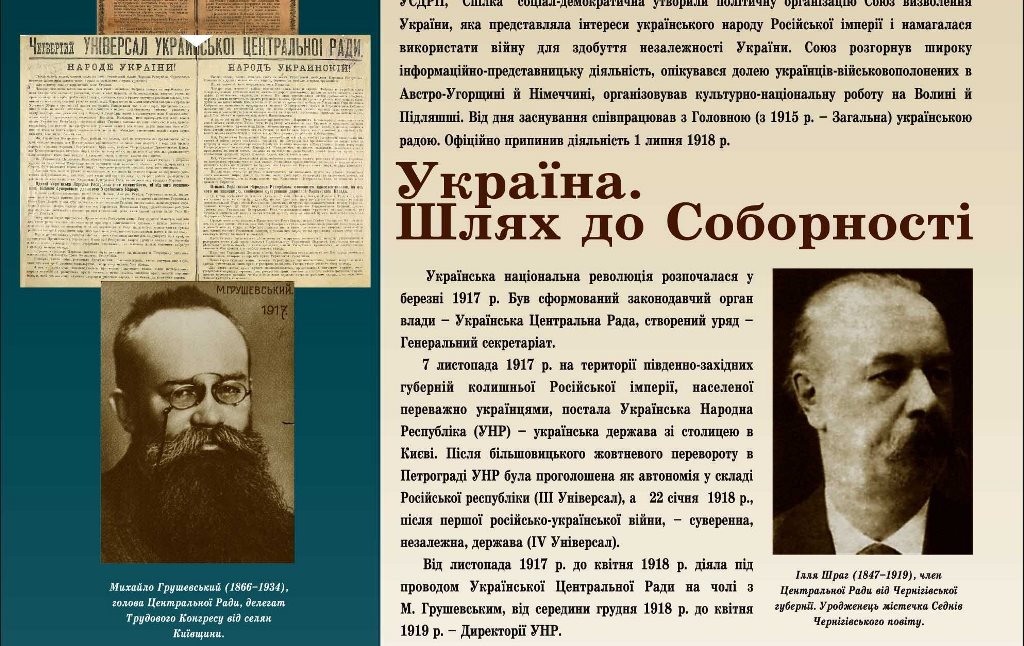
In the Chernihiv regional historical museum named after. VV. Tarnovsky exhibitions have been created and are in operation, dedicated to the Cathedral of Ukraine - "Chernigovians in the fight for Ukraine" (section) та "Ukraine. Path to Unification ", which represent documents from the collections of the museum and the Central Archive of higher authorities and administration. Both expositions provide an opportunity to follow the military and political course of events in Ukraine, in Chernihiv Oblast at the end of the 10s of the 20th century. and the desire of Ukrainians to create a single independent national state, which appeared in January 1919 year.
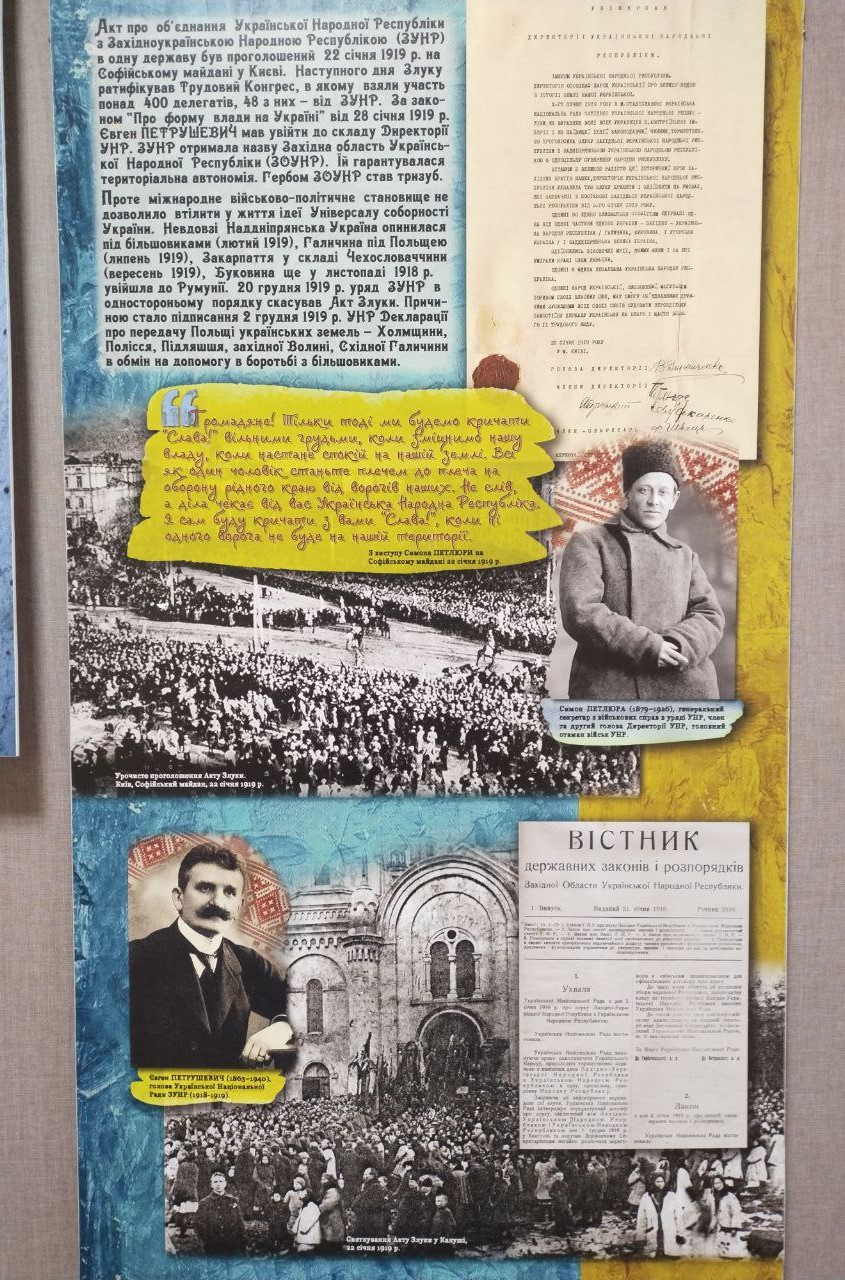
Отже, as a result of February 1917 the year of the revolution in Russia and the collapse of the Austro-Hungarian Empire during the First World War, in 1918 year, two sovereign Ukrainian states - the Ukrainian People's Republic - appeared on the map of Europe (UPR) and the Western Ukrainian People's Republic (ZUNR) with centers in Kyiv and Lviv, respectively. They differed among themselves politically, economic, social and international landmarks. However,, despite the differences, in the face of mortal danger, the leaders of the two Ukrainian states reached an agreement on unification into one cathedral state. Act of annexation of Ukrainian lands - ZUNR (Galicia, Bukovyna, Hungarian Rus) from UNR (Transdnieper Ukraine) proclaimed 22 January 1919 year on Sofia Maidan in Kyiv. The union was ratified by the Labor Congress - the revolutionary parliament of Ukraine, in which more than 400 delegates, of them 36 - from the West Ukrainian Republic. The Labor Congress temporarily handed over the Directorate of the Ukrainian People's Republic, supplemented by a representative of ZUNR, legislative and supreme power.
It was the time of the dreamed-of unification of Ukrainian lands into a single state. It was based on the ancient hopes of the Ukrainian people for a unified national state. However,, Actually, Cathedral Ukraine appeared only after the declaration of independence in August 1991 year. In the conditions of the modern Russian-Ukrainian war, conciliarness acquires greater symbolism and acuteness, because today Ukrainians need to unite for the sake of the future. The united nation in the vision of the future will certainly restore the unity of the territories.
More Stories
To the day of memory of Taras Shevchenko
Exhibition for the 130th anniversary of the Museum
Irmologion of Peter Mohyla