21 March 2026 year
Another 100th anniversary
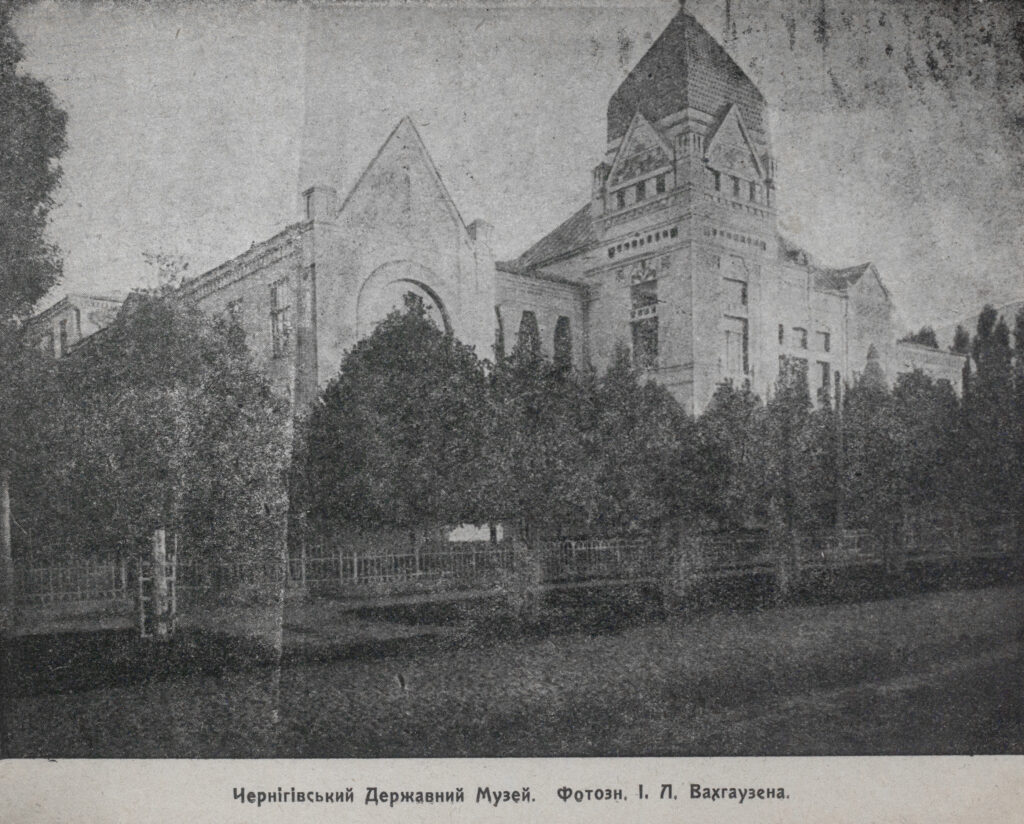
Telling about the history of the emergence and development of the Chernihiv Regional Historical Museum named after. VV. Tarnovsky, we stopped at that, that five museums of the city, having survived the First World War, revolution and change of state system, were under the leadership of a joint management body - the department of public education. This made it possible to carry out their reorganization, determine the main tasks and areas of activity of each, get rid of parallelism in work, unnecessary competition. Not only the work of each institution was put on scientific rails, and the organization of museum affairs in Chernihiv, why did departmental barriers get in the way earlier. Determination of the profile of each museum and implementation of redistribution, the exchange of museum objects made it possible to more effectively use and replenish existing collections and form new collections. 1923 year of the museum legally became departments of one institution - the Chernihiv State Museum, And in September 1925 stopped working in their old homes and started moving to new ones, common to all, rooms, physically became parts of a single institution[1].
Moving required a lot of effort and time, and two months later the mass media reported, that the Chernihiv State Museum has already been moved to the building designated for it on Selyanska Street (former Volodymyrska), where before that the District Land Administration and Silbank were located[2]. But it was not just necessary to transport museum objects, the library, archive, available equipment, but also to build expositions, having at the same time a limited resource - and personnel, and material and technical.
It was impossible to take over the whole room at once, the more so, as well as other works - research archaeological and ethnographic and collecting expeditions, examination and protection of immovable monuments, etc. - did not stop. It was decided to make expositions and open them to visitors gradually, the first, 100 years ago, historical departments began to work, ethnographic and cults: "On Sunday 21 March [1926 р.] the Chernihiv State Museum opens for visiting, who settled in the house of the former Silbank (Selyanska, № 3). Entrance for peasants and Red Army soldiers is free. For students - 5 a lot., for trade union members - 10 a lot., for others - 15 cop. The museum is open from 11 to 4 year.", - we read in the newspaper[3].
The historical department was largely created on the basis of the collection of the Museum of Ukrainian Antiquities named after. VV. Tarnovsky. "Collected by the most outstanding amateur of Ukrainian antiquities, the famous Chernihiv V.V. Tarnovsky with the participation of the second famous Chernihiv O.M. Lazarevsky" collection in four halls told about Ukrainian life and culture from the middle of the 17th to the end of the 18th century. Portraits of Ukrainian hetmans were placed in the first hall, клейноди, the precious weapon of a military officer, powder bins, Cressal, calamari etc; in the second - portraits of representatives of military officers, including women's, guns and military household items; in the third - portraits of Ukrainian figures and members of their families of the second half of the 17th - beginning of the 18th century., "extremely valuable Ukrainian women's clothing - kuntushi, boats, shoes", Slutsk belts, Ukrainian haptarism, silverware and glassware; in the fourth - Ukrainian life of the second half of the 18th century., "when the influence of Russian culture supplanted the old Ukrainian national traits"[4].
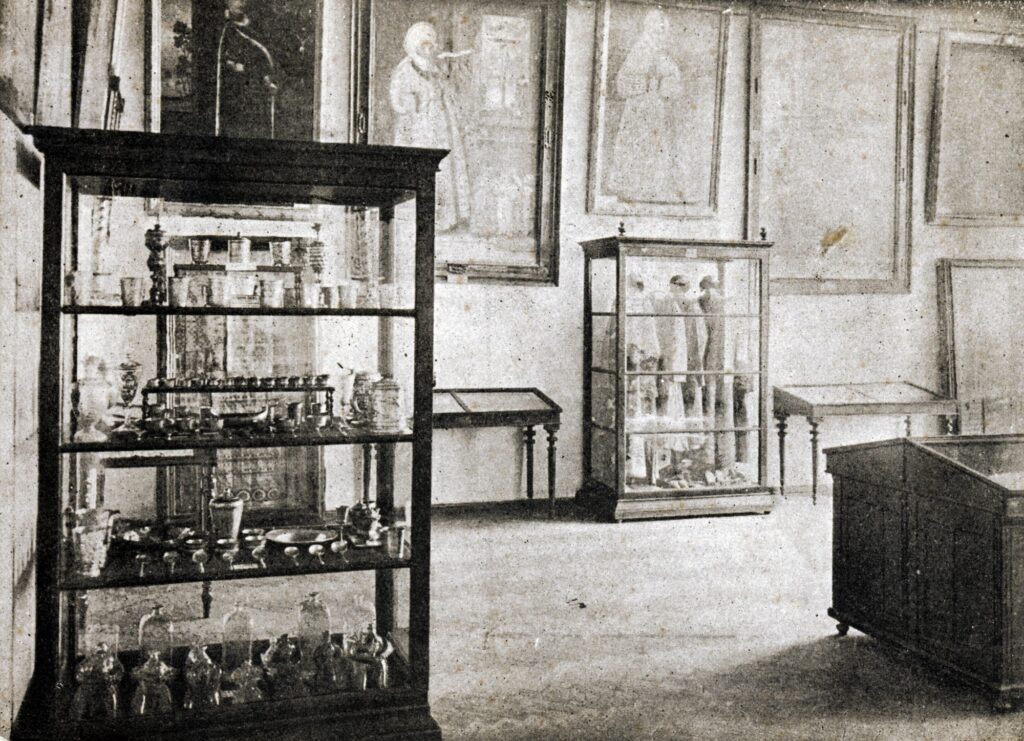
The third hall of the historical department.
Postcard "Hall of the Age of Trade Capitalism HVII–XV3rd century."
Another significant component of the department was the meeting of the historical and archaeological department (the former CHAK Museum, or the United Museum), primarily this concerned the sub-departments of archeology and "Old Chernihiv", numismatics and history of workshops.
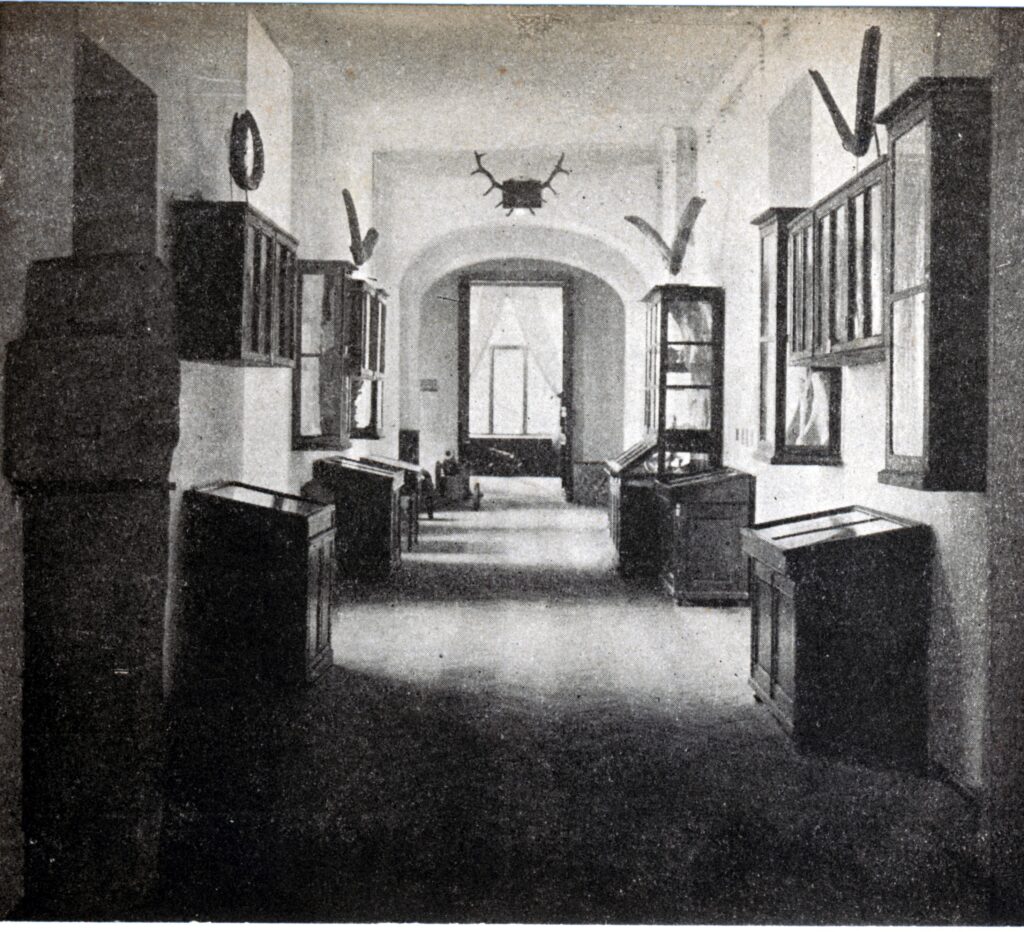
Postcard "Hall of prehistoric times"
In August 1926 the hall of Ukrainian writers T. was opened. Shevchenko, ,P. Kulisha, Л. Глібова. Do 1927 Kotsyubynskyi's "corner" and a numismatic cabinet were created in 2008. They began to organize the department of the revolution (revolutionary movements), which will tell about public and political figures of Chernihiv Oblast from the Decembrists to the present day, using the archive of the former provincial gendarmerie as a source[5]
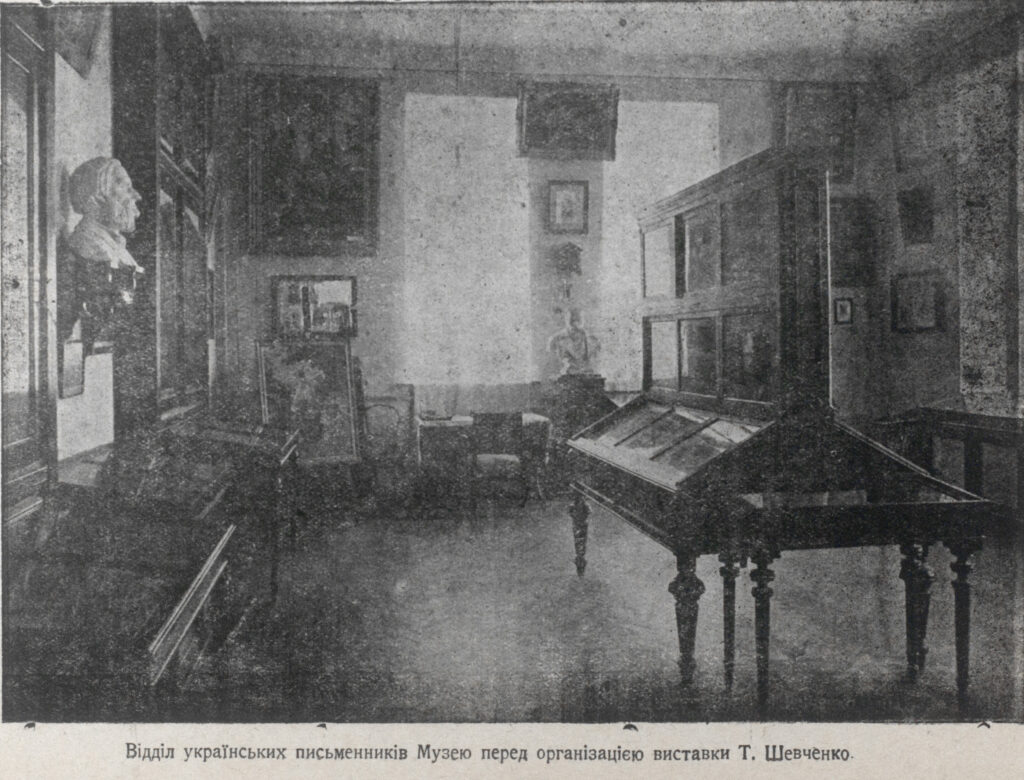
Hall of Ukrainian writers before the organization of the exhibition "T. Shevchenko"
The department of cults absorbed the collection of the Chernihiv diocesan repository of antiquities, cult sights of the United Museum and collection of V.V. Tarnovsky, as well as subjects, discovered during the survey of churches and monasteries of Chernihiv Oblast in the 1920s. Many first-class monuments of goldsmithing and embroidery were exhibited in its halls, icons and iconostases, The Gospel in precious frames and bells of the 17th–18th centuries. Among the liturgical metalwork, vestment, of manuscripts and printed works, one could see the memories of the customers and donors of monuments from all walks of life and the works of Ukrainian religious figures and masters. The robes of the icon of the Holy Trinity-Illian Mother of God attracted attention and are well known to us today., bell P. Polubotko, хрест, which was awarded to the Chernihiv regiment for taking the fortress of Azov in 1696 Dr.. тощо. And the bell, poured into 1739 year by master Andriy Yosifovych for the Church of the Nativity of the Virgin, was brought from the Domnytsky Monastery and placed at the entrance to the museum[6].
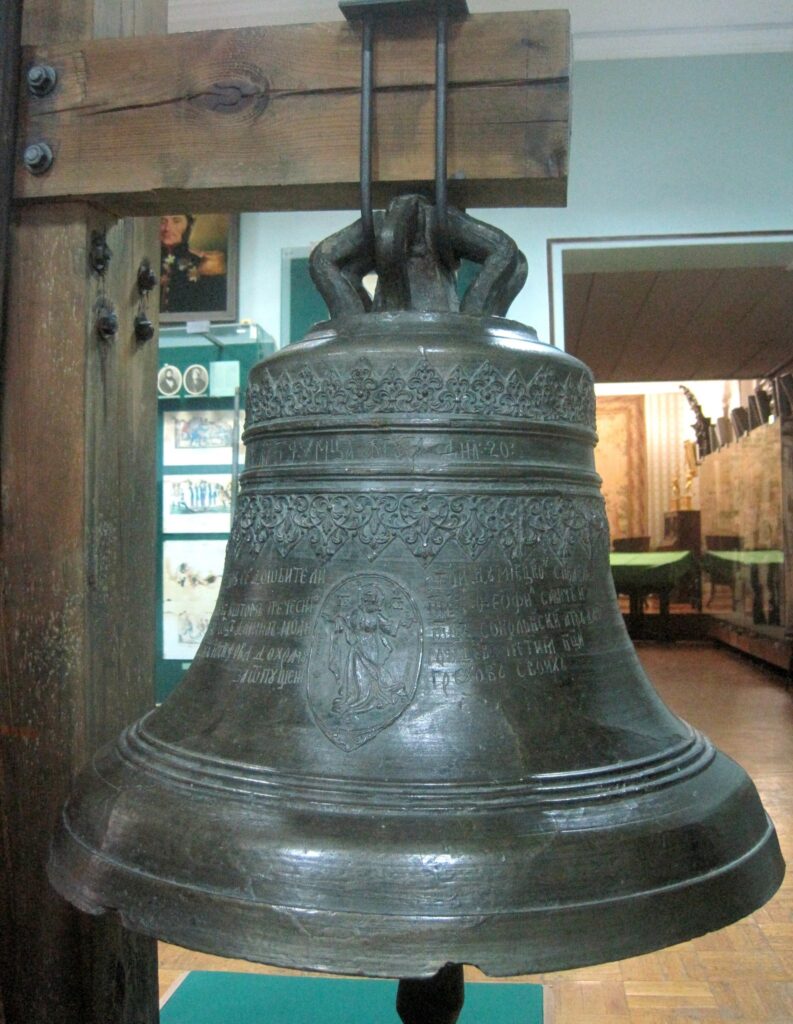
The bell of the Cathedral of the Nativity of the Most Holy Theotokos of the Domnytsky Monastery.
Інв. Number I-2717.
The mummification section was opened on the same day as the numismatics office - 8 November 1927 year, then visited the museum 800 людей. And organized by 1924 Dr.. traveling exhibition "Science or Religion", the main developer and executor of which in Chernihiv was ChDM, since October 1927 officially became a part of permanent political and educational local institutions as a separate structure - a stationary anti-religious exhibition of the Department of Cults of the ChDM[7].
The ethnographic department demonstrated folk life, Ukrainian clothing and embroidery, carpet making and pottery, tempered glass, scumbags etc; a separate hall talked about the development of handicraft production in Chernihiv Oblast. Research by museum workers of Chernihiv fairs, their assortment and repertoire of folk singers provided nutritious material for replenishment and material, and intangible part of the department[8].
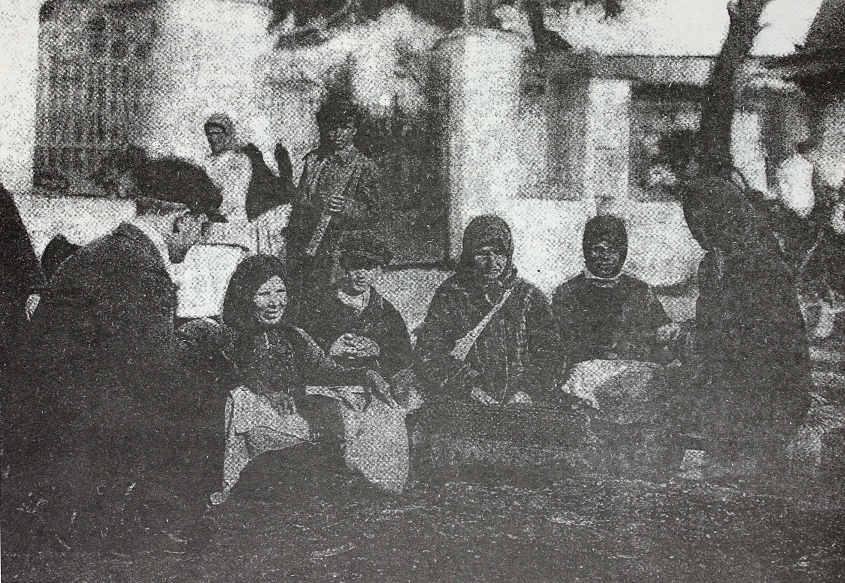
B. Luhovsky during the study of the repertoire and life of elders.
Chernihiv, "Desyatukha" fair, June 1925 Dr.. Photo by I. Wachhausen
In August 1926 the exhibition "domestic life of landlords during serfdom" was opened, where the furnished dining room was presented, bedroom and living room. "The most interesting department of the museum, which gives it a special place among the museums of Ukraine, there is a department of landlord household. In the enfilade of rooms, household items and art from the estate of Count Miloradovych and other noble estates are collected. The rooms are furnished and decorated as closely as possible to real landlord life", - wrote the Chernihiv newspaper[9].
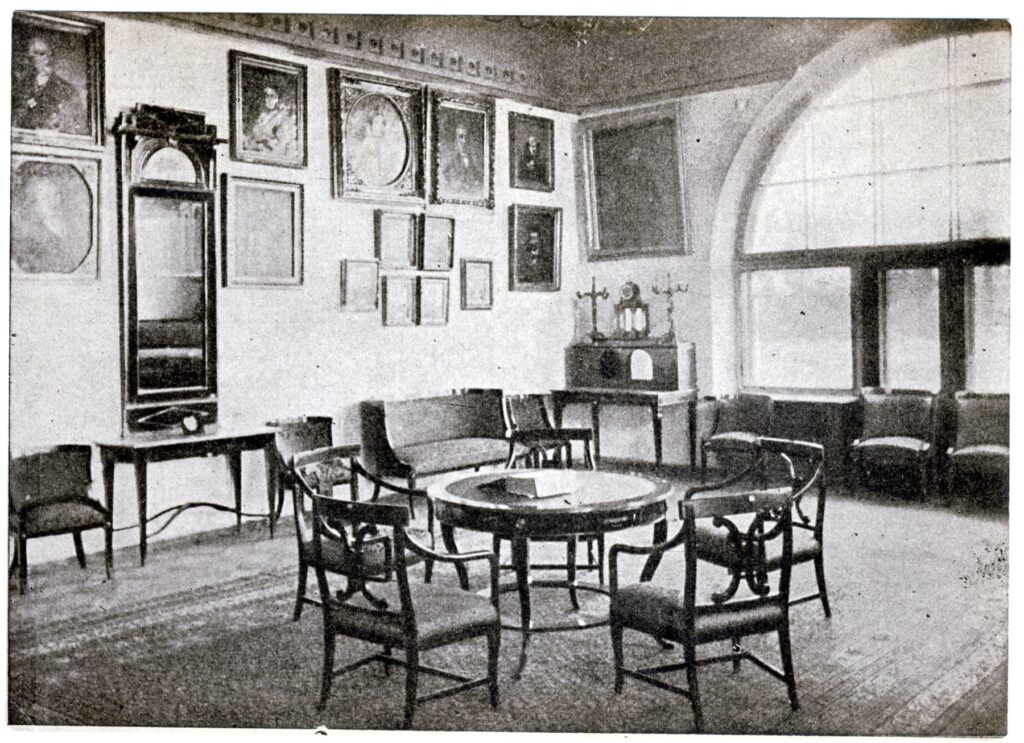
A postcard
"Department of lordly life during the times of serfdom in the 19th century. Red living room"
Do 1928 created an exposition of the section, that told about the shops, and the exhibition for the 15th anniversary of the death of M. Kotsyubinskogo[10] (For the latter, the exposition of the hall of archeology was dismantled, which was returned to its place the following year).
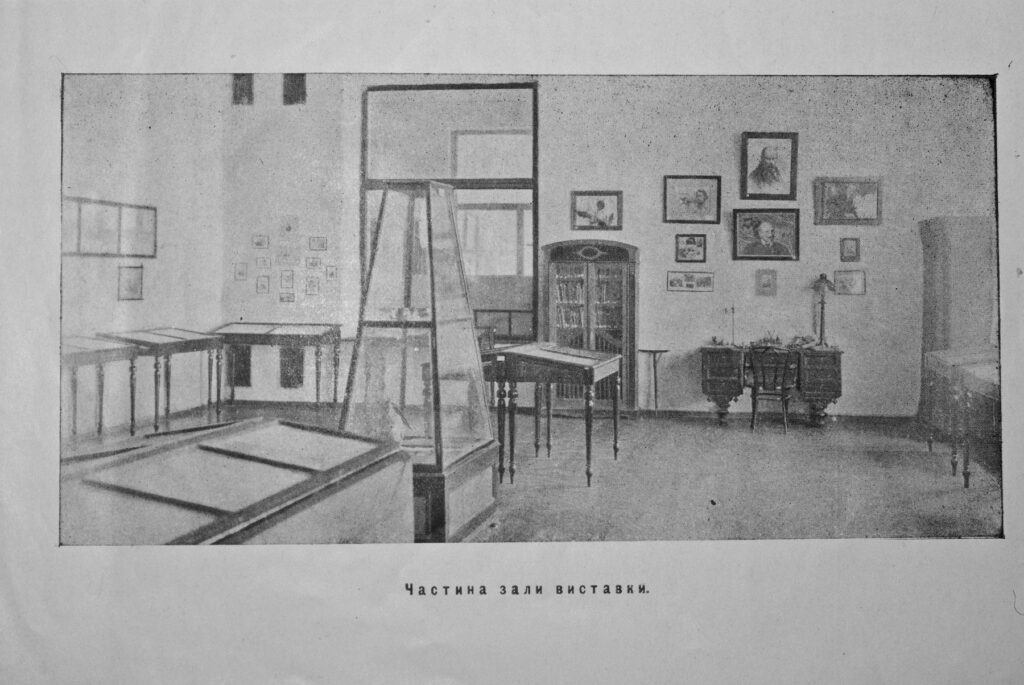
Exhibition, dedicated to M. Kotsyubinsky
Do 1929 organized the exhibition "T. Shevchenko". It was not a spontaneous decision or a "Danish" project. Museum workers explained the reason for its creation in the guide to the exhibition[11]. In 1902–1925, having a unique, one of a kind Shevchenkian, Museum named after. VV. Tarnovsky could exhibit only a small part of it. In a hurry to open ChDM in the former Silbank, the museum workers were forced due to lack of time, a little more than before, but the entire Shevchenko collection cannot be placed in the hall of Ukrainian writers, together with the "corners" of L. Tlibova and P. Kulisha. This "disturbed the general impression" of Shevchenkiana's review, while the museum always wanted to show her as fully as possible, make it available not only to specialists, and for a wide range of visitors. Now a separate hall has been allocated for her. Not only Vasyl Tarnovsky's collection was presented at the exhibition, and the acquisitions of the Chernihiv Museum, including the recently purchased Kobzar 1860 Dr.. with gift inscription T. Shevchnenko L.V. Tarnovska. The exhibition was not created according to the principle of "open funds", and as a museum exhibit, dedicated to the life and work of the Ukrainian genius, for which some original exhibits were supplemented with illustrative explanatory material, and the chronological principle of display was combined with a systematic and thematic one. In the, dedicated to the connections of T. Shevchenko with Chernihiv region, materials about the family of the collector Shevchenkiana were also presented. It was also a tribute to a great Ukrainian, адже з 1926 Vasyl Tarnovsky's name disappeared from the museum map of Chernihiv.
У березні 1929 opened an art exhibition, which included works of decorative and applied art, painting, Sculpture. Artistic furniture could be seen in its halls, European paintings, Ukrainian and Russian artists, the work of "local artists of the revolutionary time", that is, the 1910s - 1920s[12]. Art artifacts were presented here, which were already exhibited in the department of gentlemen's household and arts (which was a part of the reorganized exhibition), як-от, Kachaniv meeting O. Olive, and new receipts to ChDM, eg: "Portrait of a Girl" by Argunov, Myklashevsky porcelain, Gardner and Sachs, miniatures of the beginning of the 19th century. тощо.
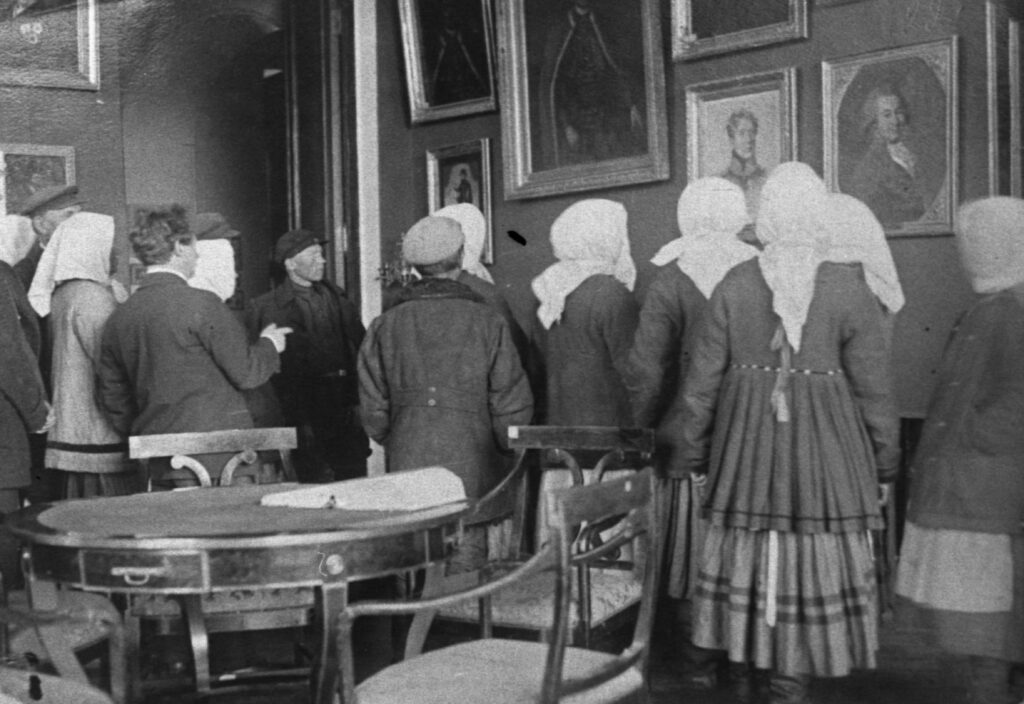
Art exhibition. The tour is led by the director of the museum M. Weinstein
It is worth noting, that in general, the process of opening new expositions and exhibitions, their complement, renewal, partly - the movement of already existing ones did not stop, and the main reason for this was the effort of the museum to fully present the existing collections and the active non-stop collection work and replenishment of the museum collection. Soon they started talking, that the current building is too small for museum treasures.
Visitors appreciated the new look of the Chernihiv Historical Museum, and specialists, colleagues in the workshop noted not only the historical and cultural value of the museum collection, and the professionalism of his employees. Here are examples from the book of impressions 1927 Dr..[13]:
– «The museum leaves a wonderful impression. The selection of exhibits is extremely interesting not only in everyday life, but also in artistic and archaeological. The exhibition was carried out with great art, which makes it very easy to inspect all the collections, having, without a doubt, of paramount importance for the national culture of Ukraine". 11.08. In. Lazarev, associate professor of Moscow University;
– "The huge treasures of the Museum, collected and combined into a single whole from separate, scattered repositories, make a great impression. The great treasures of the material and spiritual culture of Ukraine from ancient times are now fully and vividly revealed. And the skillful and expedient arrangement of the exhibits enables even a poorly prepared visitor to systematically and consistently imagine and understand our past.". 25.08. An. Swan, literature, in 1919–1923, he worked in Chernihiv in the regional KOPMIS, Museums of Ukrainian antiquities named after. VV. Tarnovsky, gubarhu;
– “In the collection of the Chernigov Museum, not only first-class monuments are striking, some of whom he knows (and if he doesn’t know, then you should know) the entire scientific world, but also an extremely thoughtful and loving exhibition of these monuments. There is no sign of those dead storerooms in the Museum, which so often kill with their appearance everyone who comes to them and deprive the monuments located in them of a large share of their charm…». 02.09. Mich. Krager, assistant curator of the State Russian Museum, Leningrad;
– “The Chernigov Museum is a true treasury for the study of Ukrainian art and life. It should be noted the scientific approach to the classification and exposure of objects, as well as exceptional care in storage. Equally important is the Museum's clear connection to current local research and public interests.". 9.10. Prof. О.І. Nekrasov, historian and theoretician of architecture;
– "Having received a deep meaning, a valuable collection of Ukrainian antiquity, The Chernihiv Museum arranged it with the utmost attention and deep love within the walls of a wonderful residence. The Museum staff is brilliantly continuing to complete and enrich the Museum, places the Museum at a high level of the entire museum business in Ukraine, skillful exposition reveals the significance of the museum's exhibits not only for his country, and for the whole world...". 23.10. E. Ya. Rudynska, director of the Museum of Ukrainian Science and Art Workers of the Ukrainian Academy of Sciences.
100 years ago, a new stage in the life of the Chernihiv Historical Museum began: unique collections are placed in a decent room under the care of experienced workers; research and educational activities flourished, the museum funds and the library were replenished, the authority of the museum in the country grew, international relations spread. On sorry, it did not last long. У жовтні 1932 the museum was thrown out of the house, which was liked by the regional committee of the party, the pressure of the totalitarian state increased significantly. The Chernihiv Historical Museum faced new challenges of fate. But that will be later.
For now, let's stop at that, that 100 Chernihiv State Museum opened its doors to visitors years ago.
Scientific Secretary Lyudmila Linyuk
[1] Association of Chernihiv Museums - Chernihiv Regional Historical Museum named after. VV. Tarnovsky
[2] Evening edition. Appendix to the newspaper "Red Banner" (Cherigov). 1925. 10 October.
[3] Working way (Chernihiv). 1926. 21 March.
[4] Weinstein M. Monuments of Ukrainian culture // Knowledge (Харків). 1929. № 5. С. 22-23.
[5] Worker's way. 1927. 8 February.
[6] Baran-Butovich S. Ludwysar wares in the Chernihiv State Museum. (Cannons and bells). Chernihiv, 1930. С. 8.
[7] Drozdov V. Exhibition "Religion or Science". 1924–1927. Chernihiv. 1928. 40 with. (Do 1931 exhibition was Zilbovich A.Kh. // DACHO. F. R-322, op.1, reference 109, sheet 42.)
[8] Luhovskyi B. materials for the fair repertoire and the life of elders in Western Chernihiv Oblast. Introduction by William Noll // Родовід. 1993. № 6. С. 83–120.
[9] From a panopticon to a first-class museum (museum collections) //Working way. 1926. 27 August.
[10] Rentar G., Likhachova S. Chernihiv Historical Museum in the 20s–90s // Genealogy. Scientific notes on the history of culture. 1996. Number 2 (14). С. 47.
[11] Karachevska L. Exhibition T. Shevchenko. Guide / Chernihiv State Museum. Ukrnauka. NGO of the USSR. Chernihiv, State Directorate, 1930. С. 9–10.
[12] Baran-Butovich S.G.. Chernihiv as an object of historical and local history excursions //Notes of the Chernihiv Scientific Society. Т. 1: Proceedings of the historical and local history section. Chernihiv., 1931. С. 128.
[13] Yasnovka L. Reviews of the work of the Chernihiv State Museum in the 1920s. 20th century //Treasury of Ukrainian culture: Collection of sciences. papers. Vip. 10. Chernihiv, 2007–2008. С. 97–99.
More Stories
Why "Yalivshchyna"?
To the day of memory of Taras Shevchenko
Exhibition for the 130th anniversary of the Museum