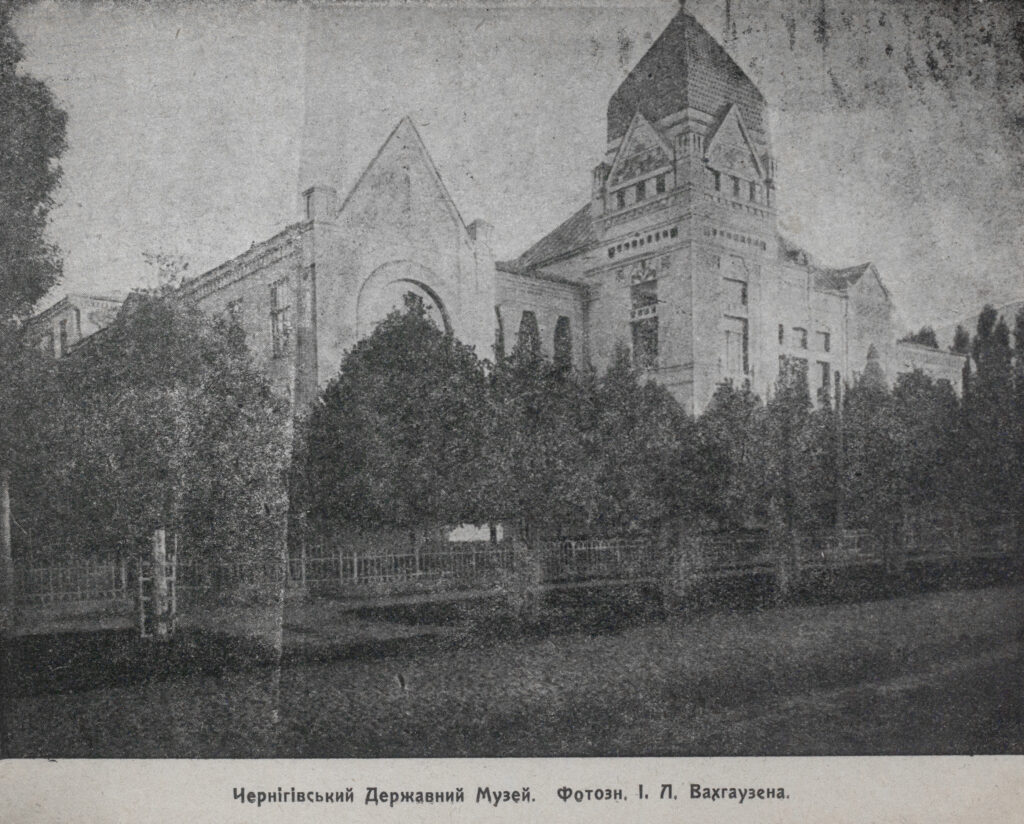
23 September 1925 the year in the Red Flag newspaper appeared a message: "In connection with the relocation of the Chernihiv State Museum to the building of the former Regional Land Administration and Silbank, all departments of the museum are closed for visits from 23 September. The opening of the museum in the new museum will be announced separately". A 10 we read in October, that according to the resolution of the regional executive committee, the building of the former land bank on Selyanska str. (now - Chernihiv Regional Universal Library named after Sofia and Oleksandr Rusovyh), a part of which is now occupied by Chernihiv Silbank, in the near future, it will be transferred exclusively for placement in it and the unification of all the museums of the city[1].
What kind of State Museum is this?, where is he moving from?, what departments does it have?? Who is moving to the Silbank building - the State Museum or the Chernihiv Museum, which ones exactly? To understand that, what the press wrote about 100 років тому, we remember again, how the museum business developed in our city.
The first public museum in Chernihiv was officially opened 14 (for a new style 26) November 1896 year. It became him Historical Museum of the Chernihiv Provincial Scientific Archive Commission (WAIT UNTIL), public organization of historical and regional studies, which had an archive in its structure, library and museum. It was located near Valu, on the corner of modern Honchoa and Preobrazhenska streets, in half the house, which was the property of the city, in the other half, the Chernihiv public library worked (preserved).
In April 1902 received the first visitors Ukrainian Museum of Antiquities VV. Tarnovsky. He belonged to the Chernihiv provincial zemstvo, which to host the collection, donated by a Ukrainian public figure and philanthropist, built a building for the craft class of a boys' orphanage on the outskirts of Chernigov (now - Regional library for youth).
In August 1908 14th All-Russian Archaeological Congress was held in Chernihiv, and preparation for it began already in 1906. Forum of historians, archaeologists, art critics, local historians continued 12 днів. As a result, two new museums became the city's museum business. Church-historical museum - Chernihiv Diocesan Repository of Antiquities (ЧЕД) was organized in October 1907 year in the theological seminary; at the end 1913 received a "registration" in the newly built building of the Mykolaiv diocesan brotherhood (now – the Regional Philharmonic Center of Festivals and Concert Programs); in 1915 year, its exhibition was closed to accommodate a hospital, and the exhibits were transported and stored in the Trinity-Illinsky Monastery.
The archaeological congress provided for the organization of an exhibition of artifacts, which would tell about the history and culture of the host country. According to tradition, exhibits of the exhibition, not taken by exhibitors, donated or specially collected for the convention, were transferred to the host city for creation City Museum. So, in 1908 In 2018, Chernihiv already had four museums.
Let's not forget, that the 1000th anniversary of the historic Chernigov contributed to the organization of the congress in our city, which was at that time, and, in addition to standard congressional affairs, one day - 6 August was dedicated to jubilee events. It was not easy to celebrate such an important date, and to perpetuate, to engrave in the memory of Chernihiv residents, so the City Duma decided to celebrate the 1000th anniversary of Chernihiv by constructing a complex of buildings for the theater, public library, public auditorium and museum. The issue of the museum was considered at the last meeting of the Chernihiv preliminary committee of the congress, jubilee commission and in the city duma, everywhere with the same result: to unite all Chernihiv museums into one whole and establish a regional museum with the name "in memory of the 1000th anniversary of Chernihiv". They argued the decision, that all museums solve the same honorable task - to collect and preserve local antiquities, have the same cultural and educational goal - to give the city's population an opportunity, first of all - to students, to see the sights and with their help to study the history of the native land. Hence the parallelism in their activities, thematic and systematic similarity of meetings, each of which was formed at the sole discretion of the museum owner. They did not see a particular difference between the museums: similar exhibits and similar defects due to lack of scientific classification, relevant premises, funds and qualified personnel. In return, unification would allow systematization of all existing collections, regularly replenish them, create new departments, discover new topics.
In view of the unifying strategy for the development of Chernihiv museums, just after the closing of the archaeological convention, they decided on a separate city museum, as an independent institution, which demonstrates its historical and cultural collection, do not create, and his collection was connected with the Historical Museum of the Chak. So in 1909 year in Chernihiv Connected (Connected) historical museum of the City and Scientific Archive Commission, in memory of the 1000th anniversary of the historical existence of the city of Chernigov. Two independent institutions - Chernihiv City Council (local self-government body) and Chernihiv Provincial Academic Archival Commission (public organization) - united their efforts in the interests of Chernihiv residents, collections and funds. Museums as separate institutions, and in reality - to the museum as a single object, that collects, keeps, studies and exhibits historical and cultural heritage, transferred the whole house to the street. Hound and built a historical exposition. Thus, the first step was taken in the matter of uniting Chernihiv museums.
But then the matter got stuck. The city could not, as thought, to build premises for the regional museum; the church department did not support the unification of museums; and the efforts of the provincial zemstvo, CHAK and the city museum commission, who have already developed the project of the charter of the united museum and invited V.L. Modzalevsky to the position of its director, failed, because thought suddenly won in the zemstvo, that the unification of museums contradicts V.V. Tarnovsky's will.
The idea of a regional museum froze. They revived it in the spring 1917 Chernihiv citizens of the year, which have been since the end of the 19th century. developed museology, краєзнавство, took care of the protection of monuments and with the beginning of the Ukrainian National Revolution united in the Public Committee for the Protection of Monuments of Antiquity and Art. The society’s opinion on the need to unify Chernihiv museums was expressed in his article “Chernihiv Museums” by V.. Modzalevskyy[2]: “… in general, the collections of Chernihiv museums are very valuable for the science of local collections, mostly Ukrainian, ancient times, which mutually complement each other, and without their study, serious work on the study of any page of Ukrainian history is hardly possible, art and literature. Chernihiv … is a city, where scientists and researchers go … so the value of Chernigov as a point, where cultural wealth is concentrated, grows even more"; “… museums and libraries are especially necessary in our country, where national self-awareness, that has awakened in the Ukrainian people, seeks support in the study of all aspects of the past and present …”. The premises of the gymnasium boarding house were proposed for the joint museum (of the old building of the boys' gymnasium). In April 1918 year it seemed, that the matter is resolved: the united museum was to receive the building of the Noble and Peasant Land Bank, but the situation in Ukraine has fundamentally changed, the museum was not on time again.
Teacher 1919 рік. Already in January, Chernihiv was captured by the Bolsheviks, and although the hostilities continued for almost three years, Soviet power in Ukraine was established for a long time. And what about the museum business? All museums were nationalized, they received one owner - the state and a joint governing body - the provincial department of public education. The new government immediately got to work. Already 12 February 1919 Dr.. "Izvestia of the Chernihiv Military Revolutionary Committee" in the post about the unification of the museums of Chernihiv writes: “The building of a former peasant bank should be used as a museum for the following reasons:: the premises of all museums are uneven”, that parallelism in work should be avoided, connect all collections, to use them in numerous exposures. 20 May among current issues, which were considered at the board of lip growths, was the first: “about museums”. They decided: "To form a provincial museum from all museums, which will be directly devoted to lip education", and on the certified copy, an extract from the protocol was added with a pen: “Due to the lack of premises for the general provincial museum, idea about setting up such a museum (in the near future) abandoned"[3].
And although the unification did not happen again, museums began to communicate more, be guided by the same regulatory documents, perform joint tasks. Since May, the "Museum Fund" department common to all museums has been operating, where the sights were received, collected by emissaries (employees) lip gloss, and then transferred to a specific museum; an evaluation commission worked for the purchase of exhibits. An excursion bureau was organized, which served all museums. New museums are being organized. У березні 1919 In 2010, work on the museification of the house of Miloradovych and 1 started working in July Museum of Manly Life and Arts. In order to adhere to the class approach, in contrast to it, in July 1920, a decision was made to create a peasant, – Ethnographic museum; opened it 1 May 1923 year on the second floor of the Hortynsky building on Magistratska Street, simultaneously with Museum of cults, who was given the first floor (now - a dental polyclinic).
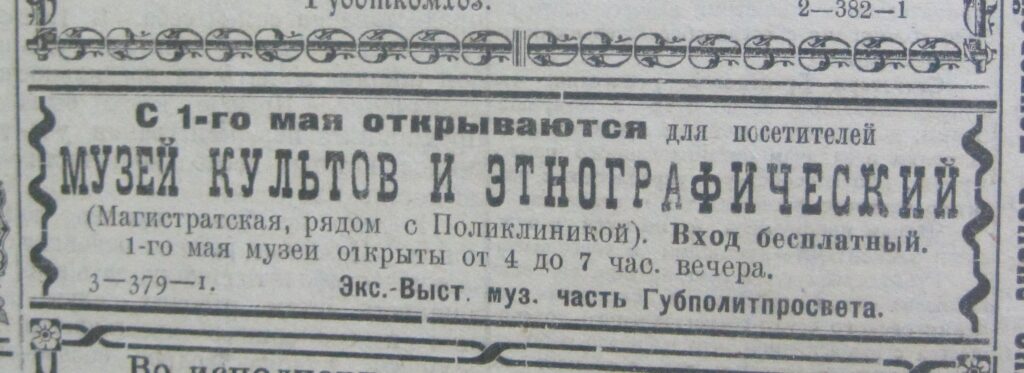
On 1921 the process of profiling museums began, moving their collections, removing some exhibits and providing others. Museum of Ukrainian Antiquities named after. VV. Tarnovsky remained a museum of Ukrainian history, but it was transferred to other exhibits of archeology, cult things, etc. The joint historical museum of the City and the Scientific Archival Commission was established Historical and archaeological. The Museum of Cults has inherited the collection of the ChYED, from which non-core artifacts were removed (numismatics, archeology, ethnography), and church items from the collections of V.V. Tarnovsky, CHAK and the City Museum. Exhibits from existing ones were used to create new museums. як-от; “In September (1921 р.) a large and painstaking work was completed to transfer the ethnographic department of the 2nd Soviet Museum to the newly organized Ethnographic Museum, the transfer is not quite finished yet”[4]; gentleman's (over time, it was ephemerally called the Museum of Life and Arts) - handed over things, which related to the life of nobles and wealthy townspeople: embroidery with beads, accessories, expensive furniture, watches etc.
Do 1923 In 2015, five museums were already operating in Chernihiv, which also received the corresponding names First, Другий, Third, Fourth and Fifth Soviet.
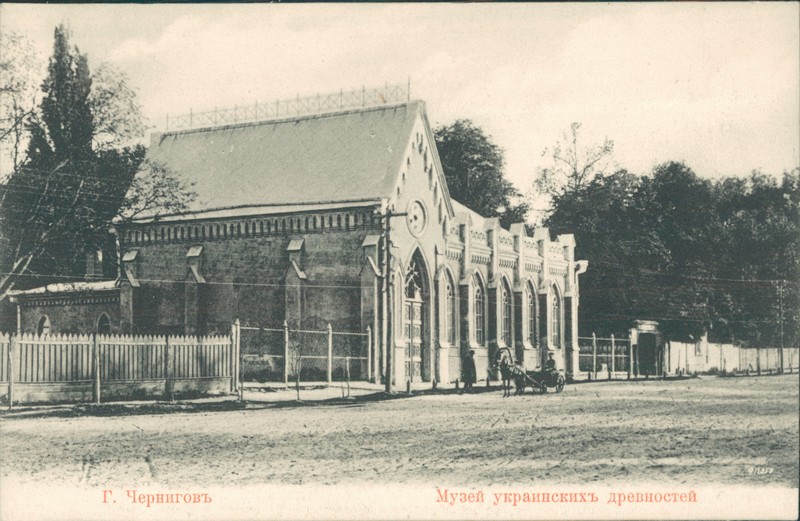
Museum of Ukrainian Antiquities named after. VV. Tarnovsky. Поштівка початку ХХ ст.
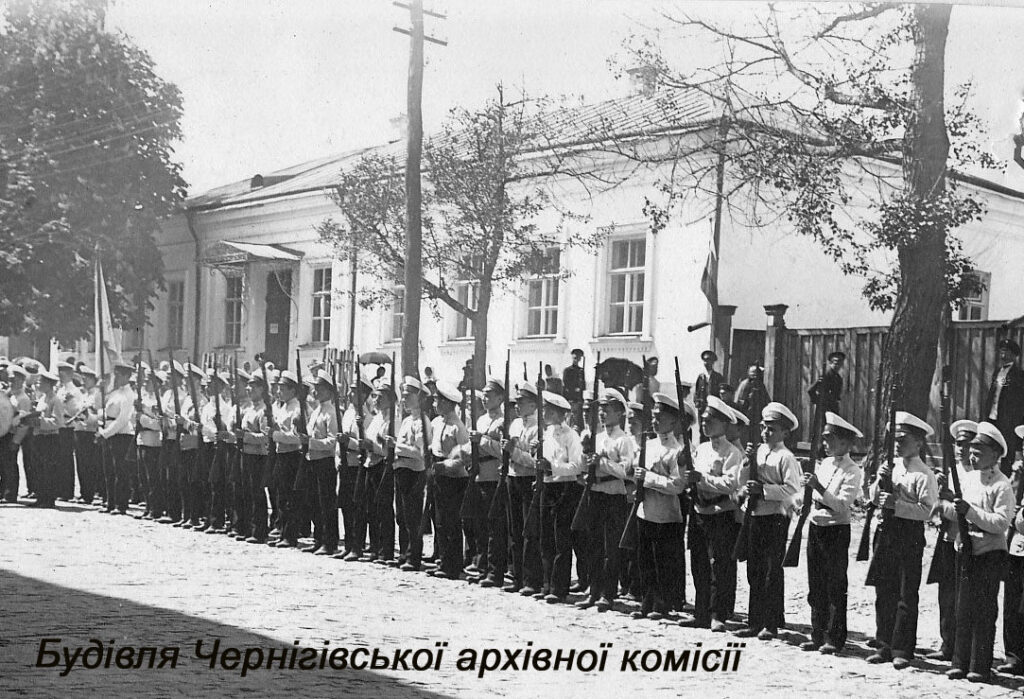
M.Chambon. Pupils of a real school.
In the background is the building of the United Historical Museum of the City and the Scientific Archive Commission, with 1923 Dr.. - Historical and archaeological department of ChDM.
Photo of the beginning of the 20th century.
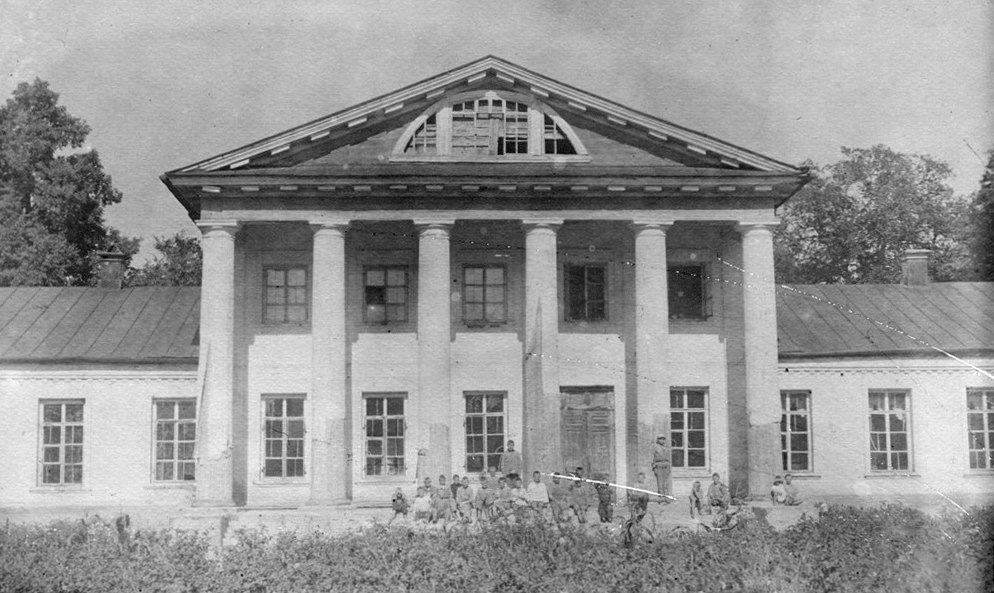
Myloradovich's house. Museum of Life and Arts. Фото 20 years of the 20th century. Archive of S. Taranushenko
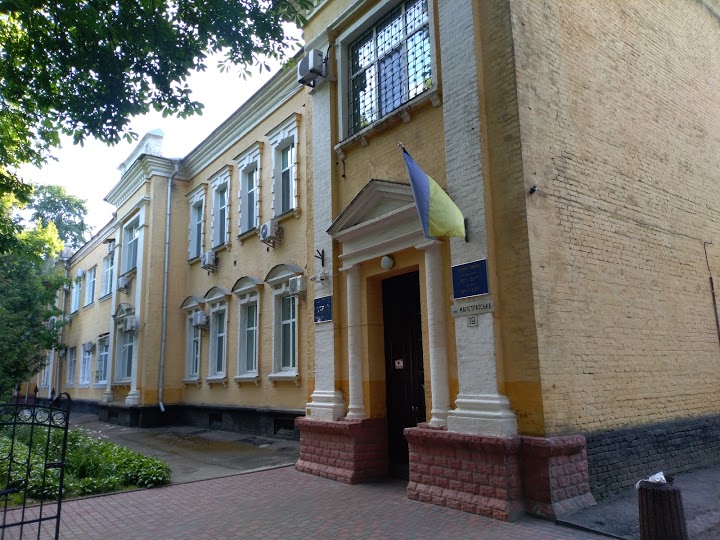
Hortynsky's house. Museums: Cults and Ethnographic. Фото 2023 Dr..
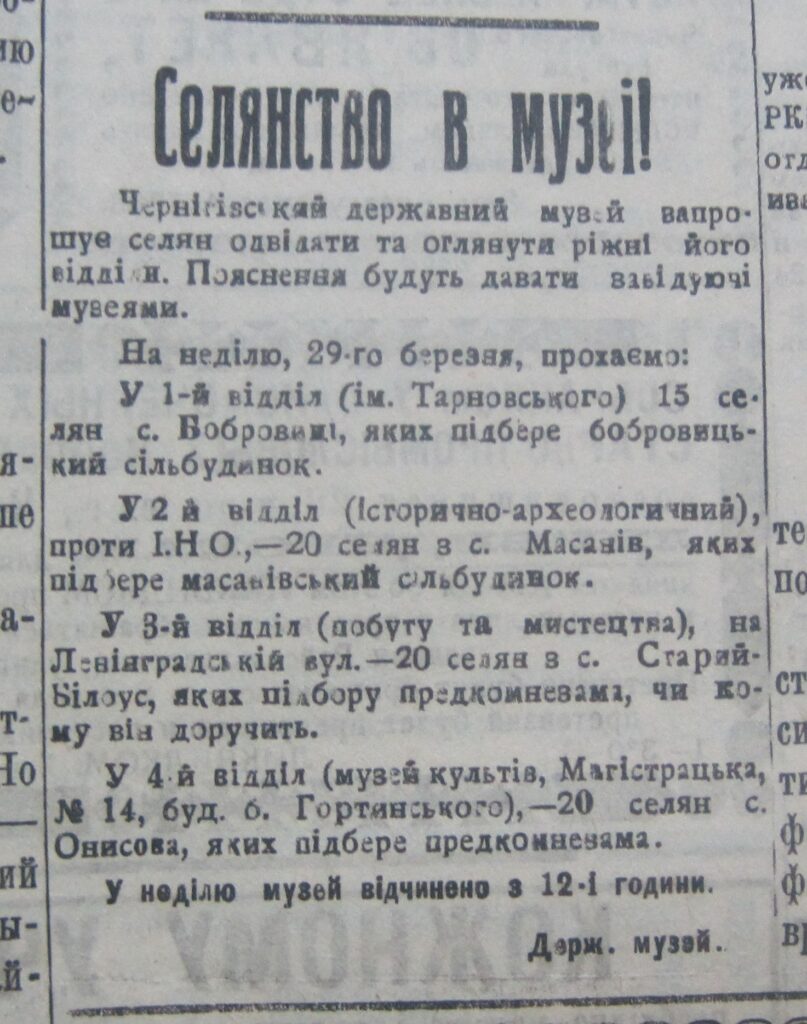
Mass media about ChDM's work with visitors. Red flag. 26 March 1925 Dr..
All museums, already reorganized according to the defined profile, remaining to work in their old premises, became departments of de jure created Chernihiv State Museum (ČDM), employees remained in their places, and V.A. became the head of the united museum. Shugaevsky, remaining in the department of the Museum of Ukrainian Antiquities. The unification of Chernihiv took place on a legal basis, administrative and managerial level.
The documents have been preserved, filled in 1924 year to the Chernihiv State Museum as a single institution and to all its departments[5]. We will find out from the ChDM questionnaire: that the Chernihiv State Museum is founded as a single entity 1923 р., in parts - with 1896 Dr.. Its main department is the Museum of Ukrainian Antiquities named after. Tarnovskyi is All-Ukrainian in type, others are provincial. The staff of the museum consisted of 13 people: zav. State Museum, he is in charge. main department, 4 zav. departments, 1 assistant in the main museum, he is the head. архіву, secretary, бібліотекар, zav. tour desk, 4 guards. Had departments: 1) Museum of Ukrainian Antiquities named after. Tarnovsky - 9735 exhibits; 2) Historical and archaeological - 5297 ex.; 3) Life and art - 1243 ex.; 4) Ethnographic - 884 ex.; 5) Cults - 3799 ex.; 6) Museum fund - approx 3000 rooms[6].
Moreover, restoration of exhibits, as far as is known, in Ukraine only in Chernihiv museums, carried out by M.I. Kasperovich[7]: it is not shown in the museum staff, apparently worked under contracts or in another structural division of the provincial government.
ChDM continued the work of the former gubKOPMIS (1919–1921), gubmuseum (1922), excursion-exhibition-museum (EVM) parts of Gubpolitosvit (1923). The activities of ChDM and its departments were covered in the columns of newspapers. They wrote about the achievements of ChDM, about the positive result of the unification, about plans, and about that, to take full advantage of it, It is impossible to "deploy all museum collections" in the existing premises[8].
And finally! 11 August 1925 The Presidium of the Chernihiv Oblast Executive Committee passed a decision on the transfer of the ChDM of the building of the Selyansky Bank (a hand. Noble Land and Peasant Land Bank). "All departments of ChDM are being transported to the building, which is occupied by the agricultural bank. Special funds have been allocated by the Chief of Political Affairs for the transportation of exhibits and maintenance of the building."[9].
All Chernihiv museums as departments of the single Chernihiv State Museum leave their premises and move to one building. A new stage in the history of the Chernihiv Historical Museum begins.
Scientific Secretary Lyudmila Linyuk
[1] Red flag. 1925. 10 October.
[2] Modzalevsky V. Chernigov museums // Chernigov region. 1917, 16, 17 October.
[3] Державний архів Чернігівської області (further - DACHO). FR-593, whop. 1, ref. 52, арк. 34.
[4] DACHO. FR-593, whop. 1, ref. 105, арк. 64. The second Soviet museum was called the United Historical Museum of the City and Scientific Archive Commission, in memory of the 1000th anniversary of the historical city. Chernihiv.
[5] DACHO. FR-593, whop. 1, ref. 1862, арк. 281–293.
[6] There only. арк. 281.
[7] DACHO. FR-593, whop. 1, ref. 1010, арк. 1зв.
[8] For more details on the activities of ChDM in 1923–1925, see: Rentar G., Likhachova S. Chernihiv Historical Museum in the 20s–90s // Genealogy (Kyiv). – 1996, № 2 (14), with. 46–48.
[9] Red flag. 1925, 16 September.
More Stories
To the day of memory of Taras Shevchenko
Exhibition for the 130th anniversary of the Museum
Irmologion of Peter Mohyla